
Mantra
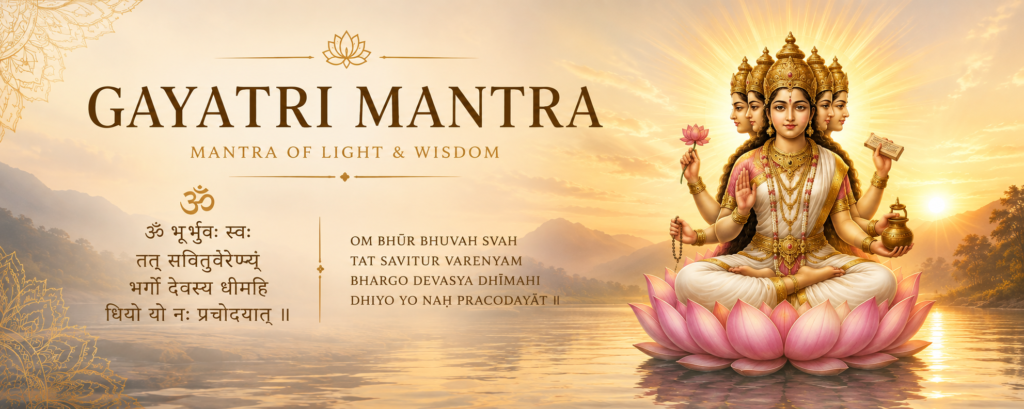
A Mantra of Light, Clarity & Awakening
ॐ भूर्भुवः स्वः
तत्सवितुर्वरेण्यं
भर्गो देवस्य धीमहि
धियो यो नः प्रचोदयात्॥
Om Bhur Bhuvah Svah
Tat Savitur Varenyam
Bhargo Devasya Dhimahi
Dhiyo Yo Nah Prachodayat
Meaning
We meditate upon the radiant Divine Light that illuminates all realms of existence. May that sacred light awaken, guide, and inspire our minds toward wisdom, truth, and higher consciousness.
The Gayatri Mantra is one of the most revered mantras of the Vedic tradition. It is traditionally associated with Savitur, the divine radiance of the sun—not simply the physical sun, but the inner light of consciousness that reveals truth and dispels darkness.
Why We Chant It
Chanting the Gayatri Mantra can be used as a practice of meditation, devotion, and inner purification. The mantra invites us to move from confusion toward clarity, from limitation toward awareness, and from darkness toward illumination.
It is especially beautiful at sunrise, sunset, before meditation, or at the beginning of a spiritual practice.
Practice
Sit comfortably with the spine tall. Bring your awareness to the breath and the heart. Take several slow breaths, then chant the mantra 3, 9, 11, or 27 times.
Allow the vibration to become more than words. Feel the mantra as a prayer:
May the light within me awaken.
May my thoughts be guided by wisdom.
May I see clearly and live consciously.
“From inner darkness, may we awaken to the light.”
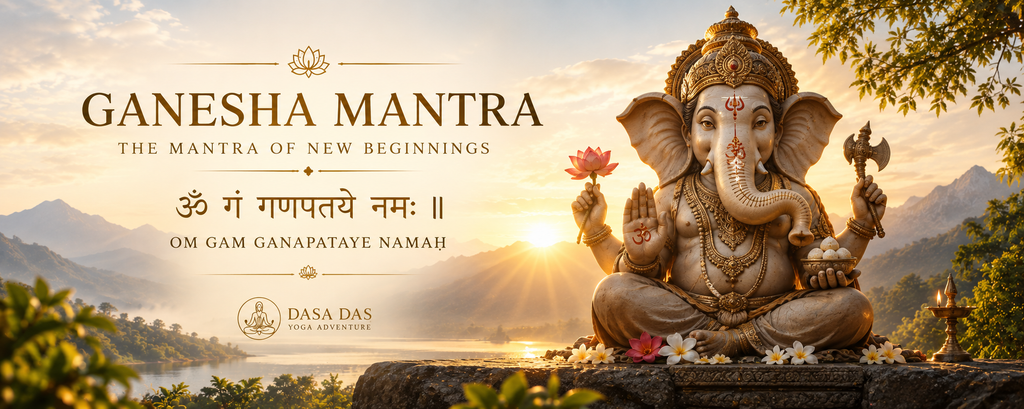
Ganesha Mantra
The Mantra of New Beginnings, Wisdom & Removing Obstacles
Ganesha is traditionally honored at the beginning of a journey, ceremony, spiritual practice, or new chapter in life. Known as the remover of obstacles and the embodiment of wisdom and discernment, Ganesha reminds us that every beginning is an opportunity to move forward with greater awareness.
The Ganesha Mantra is a simple yet powerful invocation for clarity, guidance, courage, and an open path ahead.
The Mantra
Sanskrit
ॐ गं गणपतये नमः ॥
Transliteration
Om Gam Ganapataye Namaha
Pronunciation
Om Gum Guh-nuh-puh-tuh-yay Nuh-muh-hah
Meaning
Om — The primordial vibration and universal sound of consciousness.
Gam — The bija, or seed sound, associated with Ganesha. It invokes grounding, stability, and the energy of transformation.
Ganapataye — A name for Ganesha, meaning Lord or guardian of the ganas—the many forces, energies, and beings of existence.
Namaha — “I bow,” “I honor,” or “I offer myself.”
Together, the mantra can be understood simply as:
“I bow to Ganesha, the source of wisdom and the remover of obstacles.”
The Essence of the Mantra
Obstacles are not always something standing outside of us.
Sometimes the greatest obstacles are within:
fear, doubt, attachment, distraction, old patterns, and the belief that we are not ready.
Ganesha invites us to meet these obstacles with awareness rather than resistance.
His wisdom reminds us that the path does not always need to be perfectly clear before we begin.
Sometimes we simply need enough light to take the next step.
The mantra becomes an intention:
May I have the wisdom to see clearly.
May I have the courage to begin.
May obstacles become opportunities for growth.
May the path before me unfold with grace.
Why Chant the Ganesha Mantra?
The Ganesha Mantra is traditionally chanted when beginning something new or when seeking clarity through a challenging time.
You may chant it before:
- Beginning your yoga or meditation practice
- Starting a new project or creative endeavor
- Traveling or beginning a journey
- Entering a new relationship or chapter of life
- Making an important decision
- Teaching or studying
- Beginning a retreat or ceremony
- Moving through uncertainty or change
Rather than asking for life to become free of challenges, the practice asks for the wisdom and strength to move through them consciously.
How to Practice
Find a comfortable seat and allow your body to become still.
Close your eyes.
Take a slow breath in through the nose and gently exhale.
Bring your awareness to the base of your spine and feel your connection to the earth beneath you.
When you feel settled, begin chanting:
Om Gam Ganapataye Namaha
Repeat the mantra 3, 9, 11, 27, 54, or 108 times.
You may use a mala for 108 repetitions or simply allow the mantra to flow naturally with your breath.
After your final repetition, remain in silence.
Notice what arises when you stop trying to force the path forward.
Ganesha and the Spiritual Path
Ganesha’s symbolism carries beautiful teachings for the practice of yoga.
His elephant head represents wisdom and the ability to see beyond appearances.
His large ears remind us to listen deeply.
His small eyes represent concentration and focused awareness.
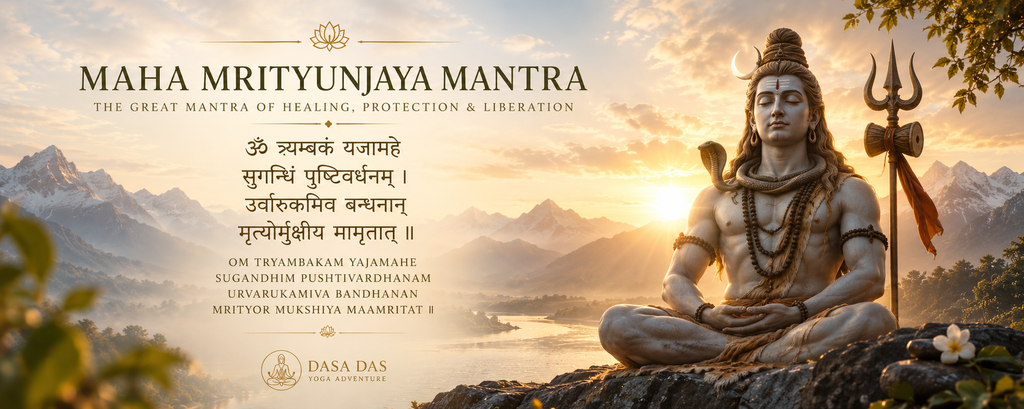
Maha Mrityunjaya Mantra
The Great Mantra of Healing, Protection & Liberation
The Maha Mrityunjaya Mantra is one of the most sacred and powerful mantras of the Vedic tradition. Dedicated to Lord Shiva, it is a prayer for healing, protection, inner strength, and freedom from fear.
Often called the Great Death-Conquering Mantra, its deeper teaching is not simply about overcoming physical death. It invites us to release our attachment to fear, suffering, limitation, and everything that keeps us from experiencing our true nature.
The Mantra
Sanskrit
ॐ त्र्यम्बकं यजामहे
सुगन्धिं पुष्टिवर्धनम् ।
उर्वारुकमिव बन्धनान्
मृत्योर्मुक्षीय मामृतात् ॥
Transliteration
Om Tryambakam Yajamahe
Sugandhim Pushtivardhanam
Urvarukamiva Bandhanan
Mrityor Mukshiya Maamritat
Meaning
Om — The primordial vibration; the sound of universal consciousness.
Tryambakam Yajamahe — We honor and meditate upon the Three-Eyed One, Lord Shiva, whose third eye represents higher wisdom and awakened consciousness.
Sugandhim Pushtivardhanam — The Divine presence that nourishes, strengthens, and sustains all life.
Urvarukamiva Bandhanan — Just as a ripe fruit naturally releases from the vine, may we be released from the attachments and limitations that bind us.
Mrityor Mukshiya Maamritat — May we be liberated from the fear and bondage of death and awaken to the eternal essence within.
The Essence of the Mantra
The Maha Mrityunjaya Mantra reminds us that healing is not only physical.
Sometimes healing means letting go.
Sometimes it means finding peace in uncertainty.
Sometimes it means releasing an old identity, relationship, fear, expectation, or way of living.
And sometimes healing is simply remembering that beneath everything changing around us, there is something within us that remains whole.
The mantra becomes a prayer:
May I move from fear into trust.
May I move from suffering into understanding.
May I move from attachment into freedom.
May I remember the eternal light within me.
Why Chant the Maha Mrityunjaya Mantra?
This mantra is traditionally chanted during times of illness, transition, uncertainty, emotional difficulty, or spiritual transformation.
The practice may support an intention of:
- Healing and restoration
- Protection and inner strength
- Releasing fear and anxiety
- Finding courage during difficult transitions
- Letting go of attachment
- Deepening meditation
- Cultivating peace and surrender
- Remembering the impermanent nature of life
The mantra can also be offered for the well-being and healing of another person.
How to Practice
Find a quiet place and sit comfortably.
Allow your spine to rise naturally and soften your shoulders. Close your eyes and take several slow, conscious breaths.
Bring your awareness to your heart.
You may silently set an intention for yourself, someone you love, or all beings.
Begin chanting:
Om Tryambakam Yajamahe
Sugandhim Pushtivardhanam
Urvarukamiva Bandhanan
Mrityor Mukshiya Maamritat
Chant 3, 9, 11, 27, 54, or traditionally 108 repetitions.
Do not worry about making the practice perfect. Allow the vibration, breath, repetition, and intention to become the meditation.
When you finish, sit quietly for a few moments.
Feel the silence after the mantra.
A Mantra for Life’s Transitions
The Maha Mrityunjaya Mantra can be especially meaningful when life asks us to surrender something we cannot control.
It teaches us that transformation is part of life.
Like the ripe fruit naturally releasing from the vine, there comes a moment when we are invited to loosen our grip and trust.
Release what is ready to be released.
Honor what is changing.
Trust what remains.
Om Shanti Shanti Shanti
May there be peace within us.
May there be peace around us.
May there be peace for all beings.